The promotion trap
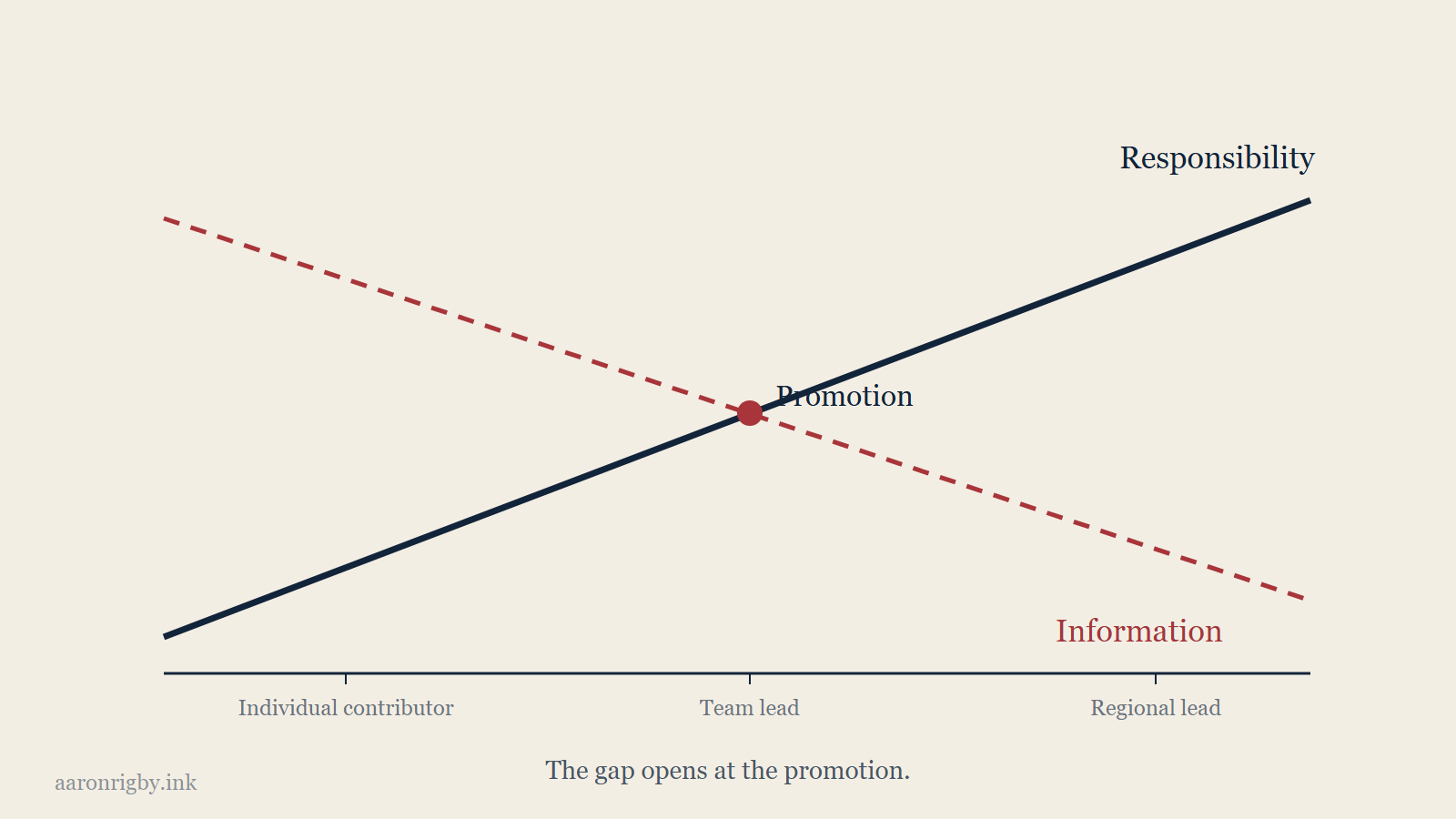
The day you get promoted out of an individual contributor role is the day you start working with worse information.
That sounds wrong, so let me lay it out.
As an IC you had everything. Every data point, every signal, every deal. Your pipeline was your world and you knew it better than anyone in the building. You could tell a colleague which deal was at risk, why, and what you were going to do about it, and you would be right.
Then comes the title. More markets, more people, more revenue, more responsibility. And here is the part that was never in the offer letter: you now have less information than you have ever had in your career.
The thing that made you good as an IC, your intimate knowledge of every deal and every relationship, gets taken off you overnight. You are managing people who manage the deals, two layers away from the information that used to sit at your fingertips. The expectation is that you make bigger calls with bigger consequences on worse inputs.
There is even an adage for it. A good leader can make a decision with sixty percent of the information. The other forty is gut, experience, pattern recognition built over years of reps.
That part is real. The scar tissue from decades of decisions, decades of managing people, decades of fear you overcame and grew out of, is exactly what companies pay for. Somewhere along the way, though, we started treating the sixty forty split as a badge of honour rather than what it actually is, which is a limitation we learned to live with.
The spec, not the failing
Think about what the human brain is built for. It is an extraordinary processor and a poor hard drive.
You can read a room, synthesise on the fly, and pivot the second the mood in a meeting shifts. Ask the same person for the exact number from a deck they saw three weeks ago, or the precise commitment they made in an email last Tuesday, and they are reaching for their phone. That is not a discipline problem. It is the spec.
I have worked alongside people with near photographic memories. Leaders who processed faster than I could, recalled a conversation verbatim from months back, and walked into any room with the full context already loaded. Keeping pace with that has always been hard for me. It does not have to be anymore, which is the whole reason I started building systems. Not to paper over a weakness. To keep pace with people who are better at this than I am.
The half that was never the problem
Look closely at what leadership instinct actually is and you find judgement. An IC wins by knowing their own patch better than anyone. A leader wins on the call: reading the room, hearing what nobody will say out loud, knowing when the numbers are lying. That part is yours. No system makes that call for you and you would not trust one that did.
The judgement was never the problem. The problem was always the other sixty percent, which is information, and information is not a talent. It is just badly stored.
Most of what you lost in the promotion still exists. It is in your team's call notes, your inbox, the CRM, the transcript of a QBR nobody has opened since. It is not gone, it is scattered, and scattered is a solvable condition.
What that actually asks of you
Two things, and neither is a note-taking habit.
Capture the raw material as it happens rather than the version you remember on Friday. What was said, not what you took from what was said. The gap between those two is where the useful detail dies.
Then link it. What your Jakarta lead said in March needs to sit next to what your Sydney lead said in June, so the pattern surfaces without you holding both in your head at the same time. That is the part every tool I ever bought was bad at, and it is the part that matters at height.
Before you build anything or buy anything, work out the question you want it to answer at seven in the morning with forty minutes in a car and a meeting you are underprepared for. Build for that question. Every tool in my graveyard answered a different one.
Adapted from chapter one of Unfinished Business, which is about the system I built to close that gap.
Read more about the book →One email, every second Friday.
What I'm learning about running commercial teams in the AI era.